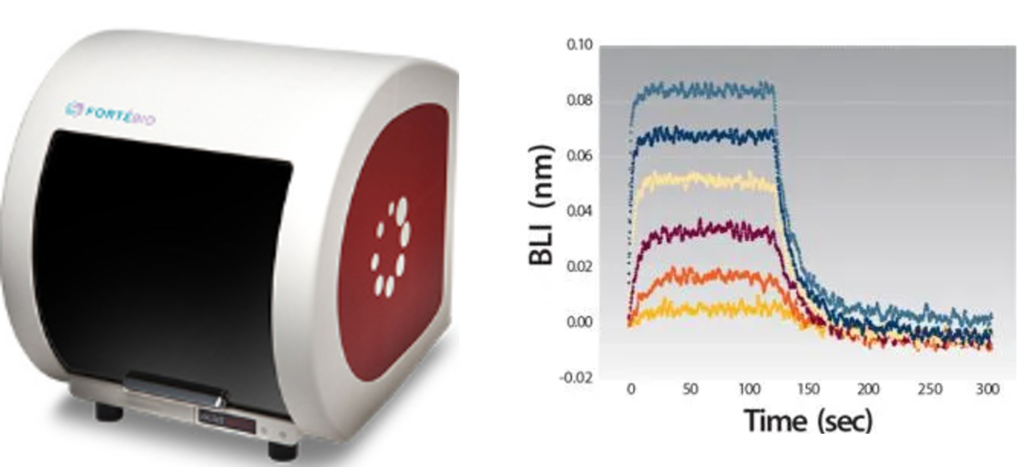
The biomolecular interaction analysis is important for biomedical research, involving to kinetically characterize binding events of relevant components, such as drugs and targets, ligands and receptors, antibodies and antigens, anti-viral and virus or any pair of interacting molecules. With ForteBio Octet platforms, we provide biopharmaceutical R&D customers with complementary molecular interaction analysis services, including antibody screening, characterization, consistency evaluation, and biomolecule interactions that contribute to your research.
Biolayer Interferometry (BLI) and Surface Plasmon Resonance (SPR) are label-free technologies for real-time measurements of binding kinetics and affinity or to determine the active concentration of an analyte, or others.
Example of applications
Antibody and antigen binding affinity measurement (see below for case study 1)
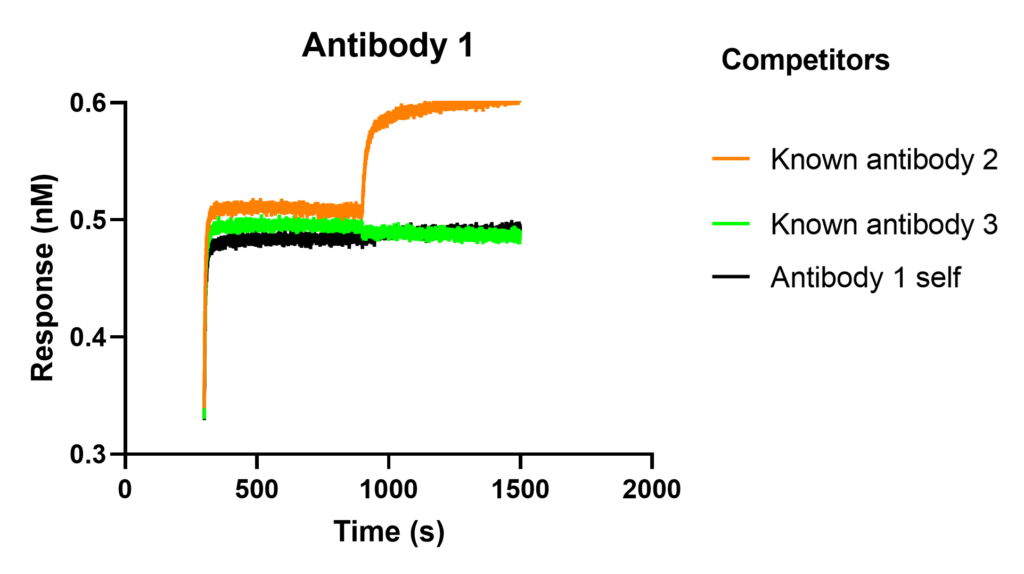
Antibody competition test (see below for case study 2)
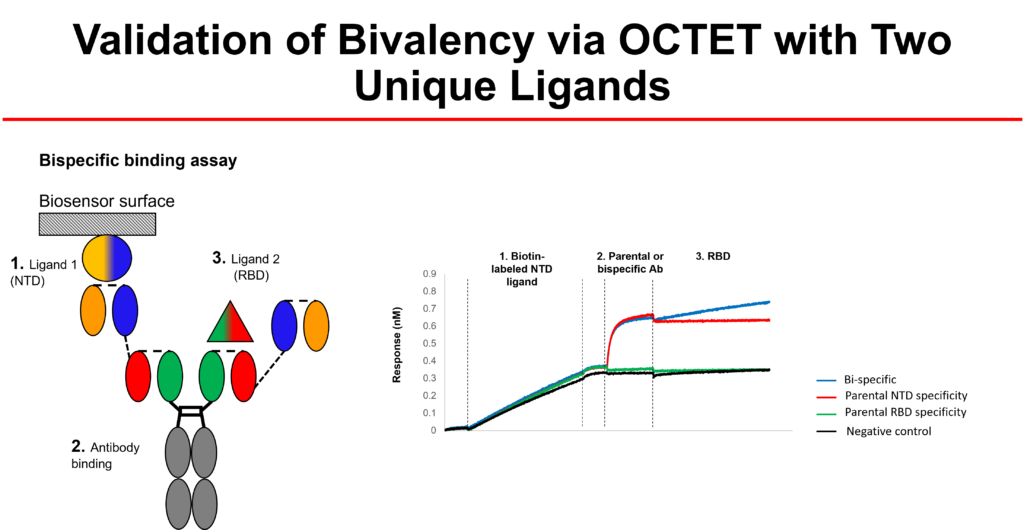
Antibody bi-specificity or multi-specificity validation (see below for case study 3)
Biomolecules interaction test
Fc receptor protein/complement affinity assay
Small molecule affinity test
More- We provide customized solutions per your request
We have a panel of antibody/protein you can choose from and they are free of charge in the quote
Case study
Case study 1 – Affinity measurement and comparison: The comparison of antibody Fab binding to SARS-CoV-2 Spike trimer with or without Nanoparticle for COVID-19 vaccine study. The binding kinetics were measured for binding to trimer with or without Nanoparticle.
Case study 2 – Antibody mapping: The study of antibody epitope is important. One way is to study the competition of newly discovered antibody with known ones. Take the picture 3 as example, the antibody 1 is tested to compete with itself (black) and another known antibody 3 (green) when binding to antigen, while this antibody 1 does not compete with known antibody 2 (orange). Therefore, the epitope of this newly discovered antibody 1 is likely similar as antibody 3’s, but different from antibody 2’s.
Case study 3 – Antibody Bi-specificity validation: A bi-specific antibody designed based on two parental antibodies that bind to NTD or RBD, respectively. The design of Octet test is to first load NTD ligand to biosensor, followed by testing binding to bi-specific or parental antibodies. The parental antibody with NTD specificity (red) and bi-specific antibody (blue) show binding to NTD with raised response, while another parental antibody with RBD specificity (green) and negative control (black) show no binding with flat response. When test the binding to RBD in next step, only bi-specific antibody (blue) show binding with raised response, while parental antibody with NTD specificity (red) doesn’t bind to RBD.